Have you ever seen the phrase “in conjunction with” in a document, email, news article, or professional conversation and wondered what it actually means?
You’re not alone. Many people search for in conjunction with meaning because the phrase sounds formal and can be confusing at first glance.
While it’s commonly used in business, education, legal writing, and everyday English, its meaning is actually quite simple.
In this updated 2026 guide, you’ll learn exactly what “in conjunction with” means, how people use it in real conversations, common mistakes to avoid, and how to understand it confidently whenever you see it.
What Does “In Conjunction With” Mean in Chat, Text, or Everyday English?
“In conjunction with” means “together with,” “along with,” or “in cooperation with.”
It is used when two or more people, organizations, events, ideas, or things work together or happen together.
Simple Definition
In conjunction with = together with another person, group, thing, or action.
Quick Examples
- The event was organized in conjunction with the local community center.
- The company launched the campaign in conjunction with a charity organization.
- The project was completed in conjunction with several industry experts.
In all these examples, the phrase simply shows cooperation or partnership.
Origin of the Phrase
The word “conjunction” comes from Latin and refers to joining or connecting things together. Over time, the phrase “in conjunction with” became common in formal English to describe collaboration, coordination, or combined efforts.
Today, it’s widely used in:
- Business communication
- Academic writing
- News reports
- Government announcements
- Professional emails
- Marketing campaigns
How People Use “In Conjunction With” in Real Conversations
Although the phrase is more common in professional settings, people still use it regularly in everyday communication.
Common Places You’ll See It
Business and Work
- Project announcements
- Partnerships
- Team collaborations
- Corporate emails
Example:
We developed this software in conjunction with industry specialists.
Education
Schools and universities often use the phrase when multiple departments work together.
Example:
The workshop was held in conjunction with the science department.
News Articles
Journalists frequently use the phrase when discussing joint efforts.
Example:
The program was launched in conjunction with local authorities.
Marketing and Events
Brands use it to highlight partnerships.
Example:
The giveaway was created in conjunction with a popular gaming company.
When It Feels Natural
The phrase sounds natural when discussing:
- Partnerships
- Joint projects
- Cooperation
- Combined efforts
- Shared responsibilities
When It Can Feel Awkward
In casual texting, it may sound overly formal.
Instead of:
I’m going shopping in conjunction with my friend.
Most people would simply say:
I’m going shopping with my friend.
Real-Life Examples of “In Conjunction With” in Sentences
Here are some practical examples that show how the phrase works in different situations.
Example 1
Message:
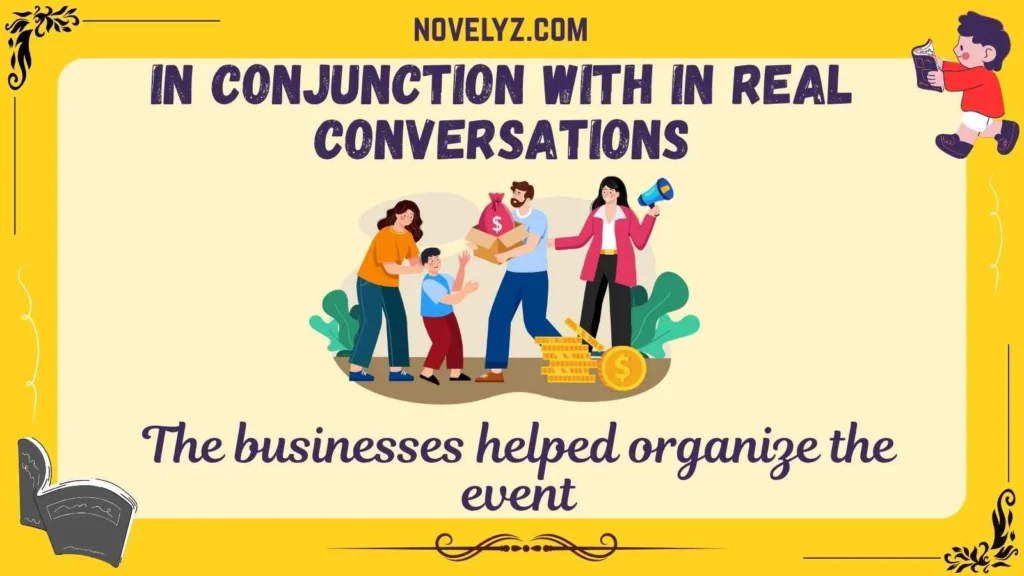
The event was organized in conjunction with several local businesses.
Meaning:
The businesses helped organize the event.
Example 2
Message:
This report was prepared in conjunction with healthcare experts.
Meaning:
Healthcare experts contributed to creating the report.
Example 3
Message:
The game update was released in conjunction with a special tournament.
Meaning:
The update and tournament happened together.
Example 4
Message:
The campaign was launched in conjunction with environmental groups.
Meaning:
The groups partnered on the campaign.
Example 5
Message:
The study was conducted in conjunction with a leading university.
Meaning:
The university participated in the research.
Common Mistakes & Misunderstandings
Many learners misunderstand how the phrase should be used.
Mistake 1: Thinking It Means Only “At the Same Time”
While timing can be involved, the phrase usually emphasizes cooperation or connection, not just simultaneous action.
Incorrect understanding:
It only means something happened at the same time.
Correct understanding:
It usually means people or organizations worked together.
Mistake 2: Using It in Very Casual Conversations
The phrase is fairly formal.
Instead of:
I watched the movie in conjunction with my brother.
Most native speakers would say:
I watched the movie with my brother.
Mistake 3: Confusing It With “Conjunction” in Grammar
In grammar, a conjunction is a word like:
- And
- But
- Or
- Because
The phrase “in conjunction with” is completely different from the grammatical term.
Mistake 4: Overusing It
Because the phrase sounds professional, some writers use it too often.
Alternatives include:
- Together with
- Along with
- In partnership with
- Working with
- Collaborating with
How to Respond When Someone Uses “In Conjunction With”
If someone uses the phrase, there’s usually no special response required.
Common Responses
- That makes sense.
- Sounds like a great partnership.
- Who else was involved?
- How did the collaboration work?
- Interesting project.
If You’re Unsure What They Mean
You can simply ask:
- Do you mean they worked together?
- Was it a partnership?
- Were both organizations involved?
Most people will clarify quickly.
Safe Alternative for Beginners
If you’re learning English, replace the phrase with:
- Together with
- Along with
- Working with
These alternatives sound more natural in everyday conversation.
Is “In Conjunction With” Still Used in 2026?
Yes, absolutely.
The phrase remains widely used in 2026, especially in professional and formal communication.
Where It’s Most Common Today
- Corporate announcements
- Business reports
- Academic publications
- Government communications
- Marketing campaigns
- Press releases
- News articles
Is It Becoming Less Popular?
Not really.
While casual communication often prefers simpler phrases like “with” or “together with,” professional writing still relies heavily on “in conjunction with.”
Professional vs Casual Usage
Professional English
The research was conducted in conjunction with medical specialists.
Casual English
We worked with medical specialists.
Both are correct, but the first sounds more formal.
Related Words and Phrases
If you’re researching in conjunction with meaning, these related expressions can also help.
Together With
Means accompanying or working alongside someone.
Example:
She completed the project together with her team.
Along With
A more conversational alternative.
Example:
He arrived along with his friends.
In Partnership With
Common in business and marketing.
Example:
The campaign was created in partnership with local charities.
Collaborating With
Emphasizes active teamwork.
Example:
The company is collaborating with researchers.
Working With
The simplest and most common alternative.
Example:
We are working with several experts.
FAQs:
What does “in conjunction with” mean?
It means together with, along with, or working in cooperation with another person, group, or organization.
Is “in conjunction with” formal English?
Yes. It is generally considered a formal or professional expression commonly used in business, academic, and official writing.
Can I use “in conjunction with” in everyday conversation?
You can, but many native speakers prefer simpler alternatives like with, along with, or together with in casual speech.
What is another way to say “in conjunction with”?
Common alternatives include:
- Together with
- Along with
- In partnership with
- Collaborating with
- Working with
Does “in conjunction with” mean the same as “with”?
In many situations, yes. However, “in conjunction with” often emphasizes cooperation, partnership, or coordinated effort more strongly than simply saying “with.”
Conclusion:
Understanding in conjunction with meaning is easier than it first appears. The phrase simply means working together, partnering together, or occurring alongside something else.
Although it sounds formal, you’ll encounter it frequently in business communication, news reports, academic writing, and professional documents.
Whenever you see “in conjunction with,” think of it as a more formal way of saying “together with” or “working with.” Once you recognize that simple idea, the phrase becomes much easier to understand and use correctly.
What’s your favorite English phrase that used to confuse you? Drop it in the comments!

I am a curious writer at Novelyz who loves exploring the true meanings behind words, phrases, and modern expressions. My goal is to explain language in a simple, clear way that feels real, relatable, and easy for everyone to understand.